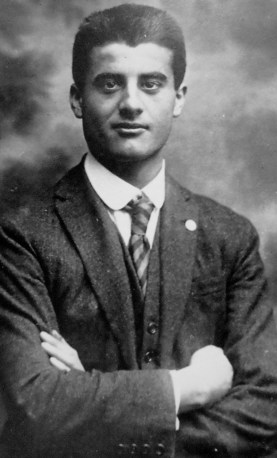
Today the Church celebrates the Feast of Blessed Pier Giorgio Frassati, who St. John Paul II called “The Man of the Beatitudes”[1] and a “living witness and courageous defender of hope on behalf of the young Christians of the twentieth century.”[2]
Pier Giorgio Frassati was born in Turin, Italy on April 6, 1901, the son of Alfredo and Adelaide Frassati. Pier Giorgio’s father owned the anti-Fascist Italian newspaper La Stampa and was influential in Italian politics, holding positions as an Italian Senator and Ambassador to Germany. His mother was an artist.
Neither of his parents were particularly pious, in fact, his father was an agnostic. But his mother saw to it that he and his sister Lucia received the sacraments. Consumed by their own interests and activities, his parents were unaware of the deep faith and spiritual movement in Pier Giorgio’s heart and mind, and his love for Jesus.
At an early age, Pier Giorgio joined the Marian Sodality and the Apostleship of Prayer. He obtained permission to receive daily Communion, which was rare at that time. He assisted at daily Mass, received Holy Communion, and spent much time in intense personal prayer after Mass. He also had special devotion to the Blessed Mother. His intense spiritual life moved him to action. At 17, he joined the St. Vincent de Paul Society to serve the sick and needy. Like his father, He also became a political activist. But instead of following the steps of his father, he chose to pursue a civil engineering degree, much to his father’s disappointment.


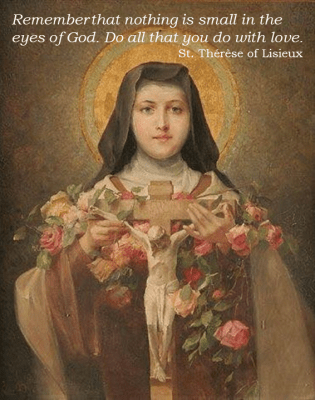 Today the Church celebrates the Feast of St. Thérèse of Lisieux, the “Little Flower.” St. Thérèse (1873-1897) was a French Carmelite nun who died in obscurity at the age of 24. Her autobiography Story of a Soul detailed her “Little Way;” doing everything, even the most common and menial tasks, for the love and glory of God. Her thoughts resonated with both religious and laity alike, quickly expanding her renown. She was canonized in 1925 by Pope Pius XI. She is one of only 36 Doctors of the Church.
 Calling Couples to Christ