Stand in the Breach – Part II

Tags

, , ,

Stand in the Breach 2

We continue our study of Bishop Thomas J. Olmsted’s Apostolic Exhortation to Catholic Men, issued on the Feast of the Archangels, September 29, 2015 “as an encouragement, a challenge, and a calling forth to mission” in the battle for the family.

Last week, we outlined what it means to be a Christian man (Stand in the Breach – Part I). This week we will look at how a Catholic man is to love and why fatherhood is crucial for every man.

Continue reading

Stand in the Breach

Tags

, ,

And I sought for a man among them who should build up the wall and stand in the breach before me for the land, that I should not destroy it; but I found none. Ezekiel 22:30

Repairer of Broken Walls_01

There is a battle raging around us that is deeply wounding spouses, children and families. Satan hates families and is out to destroy them. Saint John Paul II said “The future of the world and of the Church passes through the family” (Familiaris Consortio, 75). Satan is out to destroy families so that He can destroy not only the Church, but the world.

Bishop Thomas J. Olmsted of the Diocese of Phoenix, Arizona has issued a clarion call to men to engage in the battle for the family. Just last week, on the Feast of the Archangels, September 29, 2015, Bishop Olmsted issued an Apostolic Exhortation to Catholic Men “as an encouragement, a challenge, and a calling forth to mission.”

Continue reading

Family, Become What You Are

Tags

papal-visit-2015-logo-usa

Pope Francis during his Apostolic Journey to the United States of America this week had this to say on the importance of family and how it is being threatened:

How essential the family has been to the building of this country! And how worthy it remains of our support and encouragement! Yet I cannot hide my concern for the family, which is threatened, perhaps as never before, from within and without. Fundamental relationships are being called into question, as is the very basis of marriage and the family. I can only reiterate the importance and, above all, the richness and the beauty of family life. (Visit to Congress of the United States of America, 9/24/15)

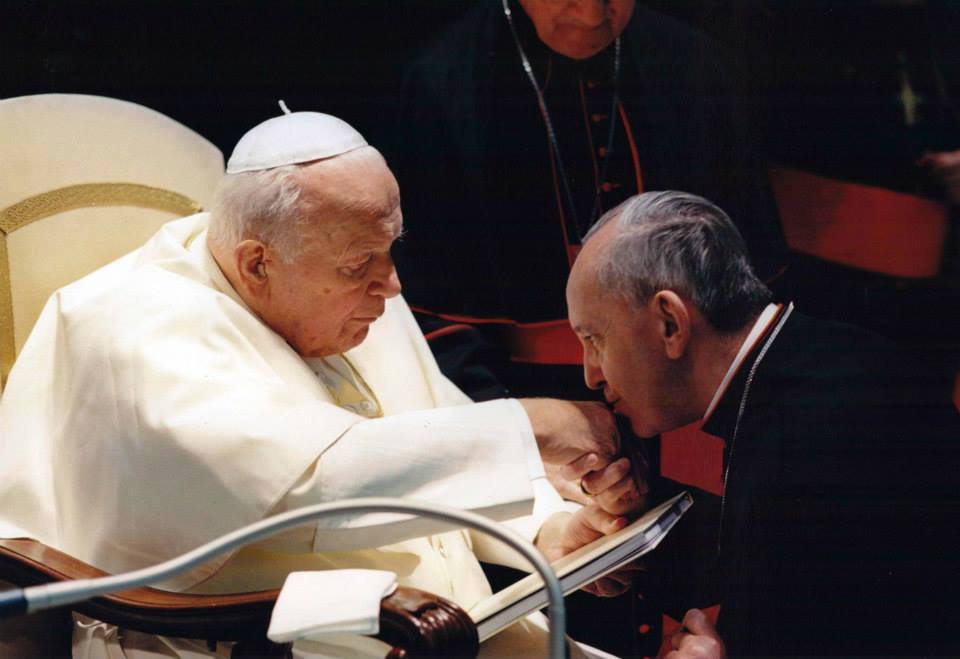
PJII with future Pope FrancisFor centuries, the family has been called Ecclesia Domestica or the “domestic church.” But it was Pope Saint John Paul II who brought new insight and application to the Biblical vision of the family when he wrote Familiaris Consortio. Man is created in the image of the God, who is love. God has called man to love.

Continue reading

Love is Our Mission: The Family Fully Alive

Tags

,

WMF_2015_Love Mission

Marriage and family life is in crisis!

According to a recent study, the marriage rate in America declined by more than 50 percent from 1970 to 2010. At the same time, the number of unmarried couples cohabitating increased more than seventeen-fold between 1960 and 2011. The presence of children in America has also declined significantly from a fertility rate of 3.65 children average per woman in 1960 to 1.89 in 2011. This rate is below the “replacement level” of 2.1, the level at which the population would be replaced through births alone.*

Pope Francis_Marriage

The Catholic Church has long recognized the importance of marriage and family life for the good of society. In the last 100+ years, the popes have consistently taught on marriage and family. Some of the most notable documents include:

Continue reading

Part II – Be Imitators of God

MatrimonyLast week, we began a study of Ephesians 5:21-33 — perhaps one of the most misunderstood passages in Scripture. We discovered that St Paul’s discourse on the roles of husbands and wives in marriage should be understood as an analogy of the image of the relationship between Christ and the Church.

This week, we will continue the study by looking at the sacrament of marriage from the dimensions of covenant and grace and as a sacramental sign.

Continue reading

Ephesians 5: Be Imitators of God

Eph 5-21_01“Wives, be subject to your husbands…” (Eph 5:22). So begins one of the most controversial and misunderstood passages in Scripture. When this passage is read at Mass, women are indignant while their husbands brim with delight. Taken out of context, this verse has caused great hardship to women and marriages throughout the centuries.

But when this verse is read in the context of St. Paul’s discourse on marriage in Ephesians 5, it describes the key to a joy filled, loving marriage relationship. Often overlooked is the verse prior to the one quoted above, “Be subject to one another out of reverence for Christ” (Eph 5:21). Husbands and wives are called to mutual submission to each other out of reverence for Christ. According to Pope St. John Paul II in his epic work, Man and Woman He Created Them: A Theology of the Body (TOB), Ephesians 5:21-33 “cannot be correctly understood except in the broad biblical context…the ‘crowning’ of the themes and truths that ebb and flow like long waves through the Word of God revealed in Sacred Scripture” (TOB, 87:3).

In this post, we will delve into John Paul II’s TOB to develop an understanding of the beauty of the relationship between man and woman as God intended at the beginning of creation, especially in relation to the misunderstanding of the submission of the woman to the man. This week, we will look at the Scripture. Next week, we will look at the sacrament of marriage as covenant and as a sacramental sign.

Continue reading

Tapping into Grace: The Sixth Stone Jar

Tags

Jar6This week we conclude our reflection on the Wedding Feast at Cana (Jn 2:1-11) where Jesus performed His first miracle. He changed ordinary water into an abundance of extraordinary wine.

In Scripture wine symbolizes joy! Jesus wants you to know life-producing joy in your marriage: “I came that they may have life, and have it abundantly” (Jn 10:10). So how can you receive this grace that Jesus wishes to pour into your marriage?

We propose that, just as there were six stone jars at Cana, there are six “jars” which we need to fill with water (our efforts) so that Jesus can turn it into wine.

In the preceding posts, we have discussed “Follow Christ,” “Read Scripture,” “Receive the Eucharist,” “Pray Together” and “Form Community.” This week we will “fill” the final stone jar: “Forgive Each Other.”

Continue reading

Tapping into Grace: The Fifth Stone Jar

Jar5For many weeks we have been on a spiritual pilgrimage, reflecting on the Wedding Feast at Cana (Jn 2:1-11). Here Jesus performed His first miracle by changing ordinary water into a superabundance of extraordinary wine.

Wine symbolizes joy! Jesus wants you to know fruitful and abundant joy in your marriage. So how can you receive this grace that Jesus wishes to pour into your marriage?

We propose that, just as there were six stone jars at Cana, there are six “jars” which we need to fill with water (our efforts) so that Jesus can turn it into wine.

So far, we have discussed four of the six stone jars: “Follow Christ,” “Read Scripture,” “Receive the Eucharist,” and “Pray Together.” This week we will “fill” the fifth stone jar: “Form Community.”

Continue reading

Tapping into Grace: The Fourth Stone Jar

Jar4For the last several weeks, we have been reflecting on the Wedding Feast at Cana where Jesus performed His first miracle (Jn 2:1-11). He turned ordinary water into an overabundance of extraordinary wine.

Wine symbolizes joy! Jesus wants you to know abundant and fruitful joy in your marriage. In the last three posts, we have looked at ways to receive the grace that Jesus wants to pour into your marriage.

As we have mentioned in our previous posts, just as there were six stone jars at Cana, we propose that there are six “jars” which we need to fill with water (our efforts) so that Jesus can turn it into wine.

So far, we have discussed three of the six stone jars: “Follow Christ,” “Read Scripture,” and “Receive the Eucharist.” This week we will “fill” the fourth stone jar: “Pray Together.”

Continue reading

Tapping into Grace: The Third Stone Jar

Jar3We have been reflecting on the Wedding Feast at Cana where Jesus performed his first miracle (Jn 2:1-11). He turned ordinary water into an overabundance of the finest wine.

Wine symbolizes joy! Jesus wants you to know abundant and fruitful joy in your marriage. In the last two posts, we have looked at ways to receive the grace that Jesus wants to pour into your marriage.

Just as there were six stone jars at Cana, we propose that there are six “jars” which we need to fill with water (our efforts) so that Jesus can turn it into wine.

We have discussed the first and second stone jars: “Follow Christ” and “Read Scripture.” This week we will “fill” the third stone jar: “Receive the Eucharist.”

Continue reading